
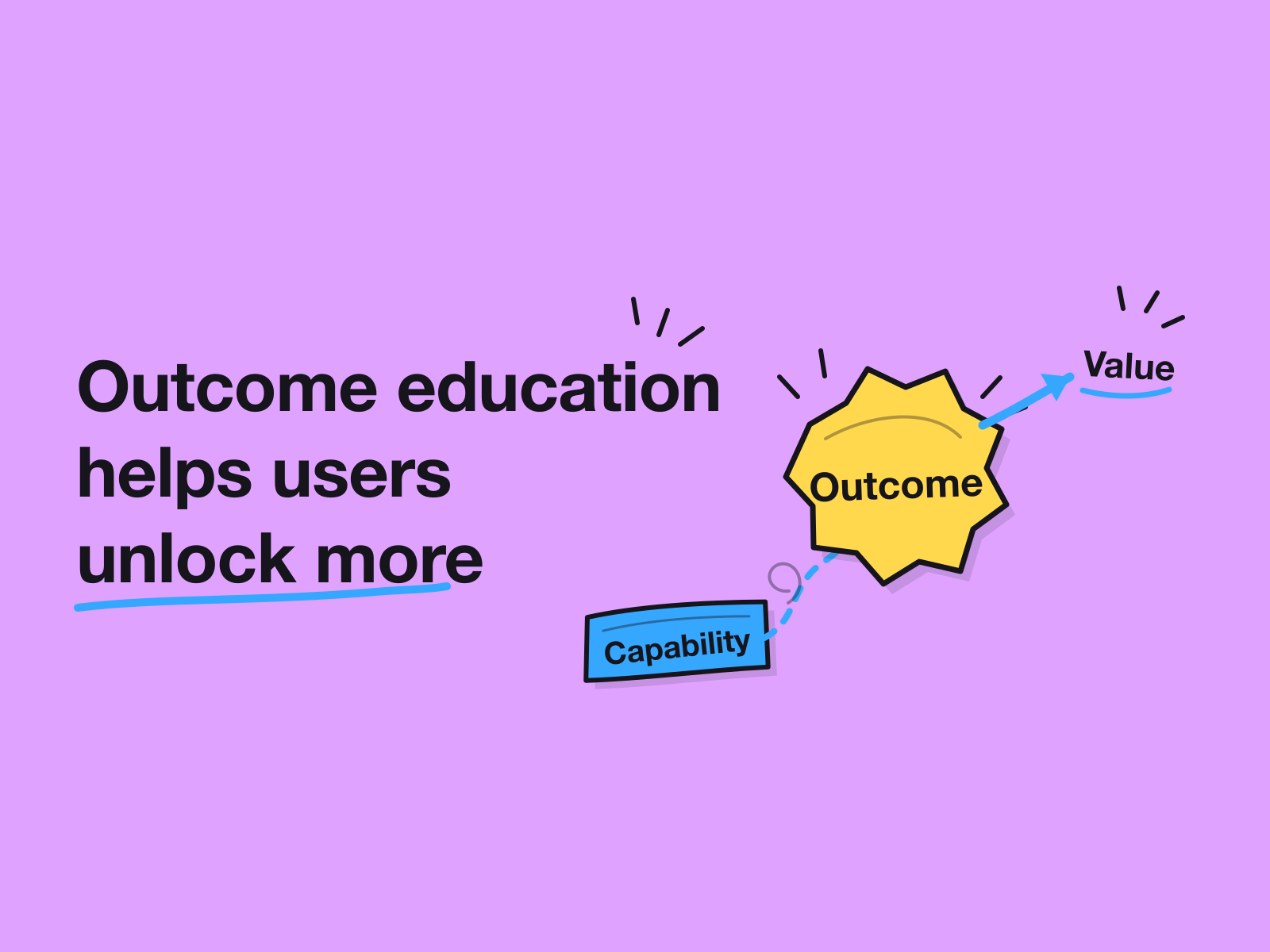
AI products are becoming remarkably easy to access. Open a website. Describe what you want. Start creating.
But easy access doesn’t always lead to a good outcome.
A user can understand the interface, find the right feature, and still walk away disappointed. The problem isn’t necessarily the product itself. They may not know how to describe the task clearly, provide enough context, evaluate what AI produces, or iterate toward something better.
This creates a different kind of education problem for AI products.
Teaching users what a feature does is one thing. Helping them learn how to get a good result from it is another.
I think of the second as outcome education.
As AI products become more capable, I think this distinction will matter more: the product can provide the capability, but users may still need help turning that capability into value.
1. Teaching the feature is no longer enough
With many traditional software products, learning how a feature works gets you much closer to the expected result.
Click here. Choose this setting. Follow these steps.
Generative AI adds another layer.
The product may provide the capability, but the quality of the outcome can also depend on how the user works with it:
Understand the task → Express the intent → Provide context → Generate → Evaluate → Iterate
Two people can use exactly the same AI product and walk away with completely different impressions.
- One enters a vague prompt, gets a mediocre result, and thinks this product isn’t very good.
- Another breaks the task down, adds context, reviews the first output, adjusts the instruction, and eventually gets something genuinely useful.
The model didn’t change.
The user’s ability to work with it did.
That creates an interesting product problem.
Traditional feature education asks: “Does the user know how to use this?”
AI products increasingly need to ask another question: “Does the user know how to succeed with this?”
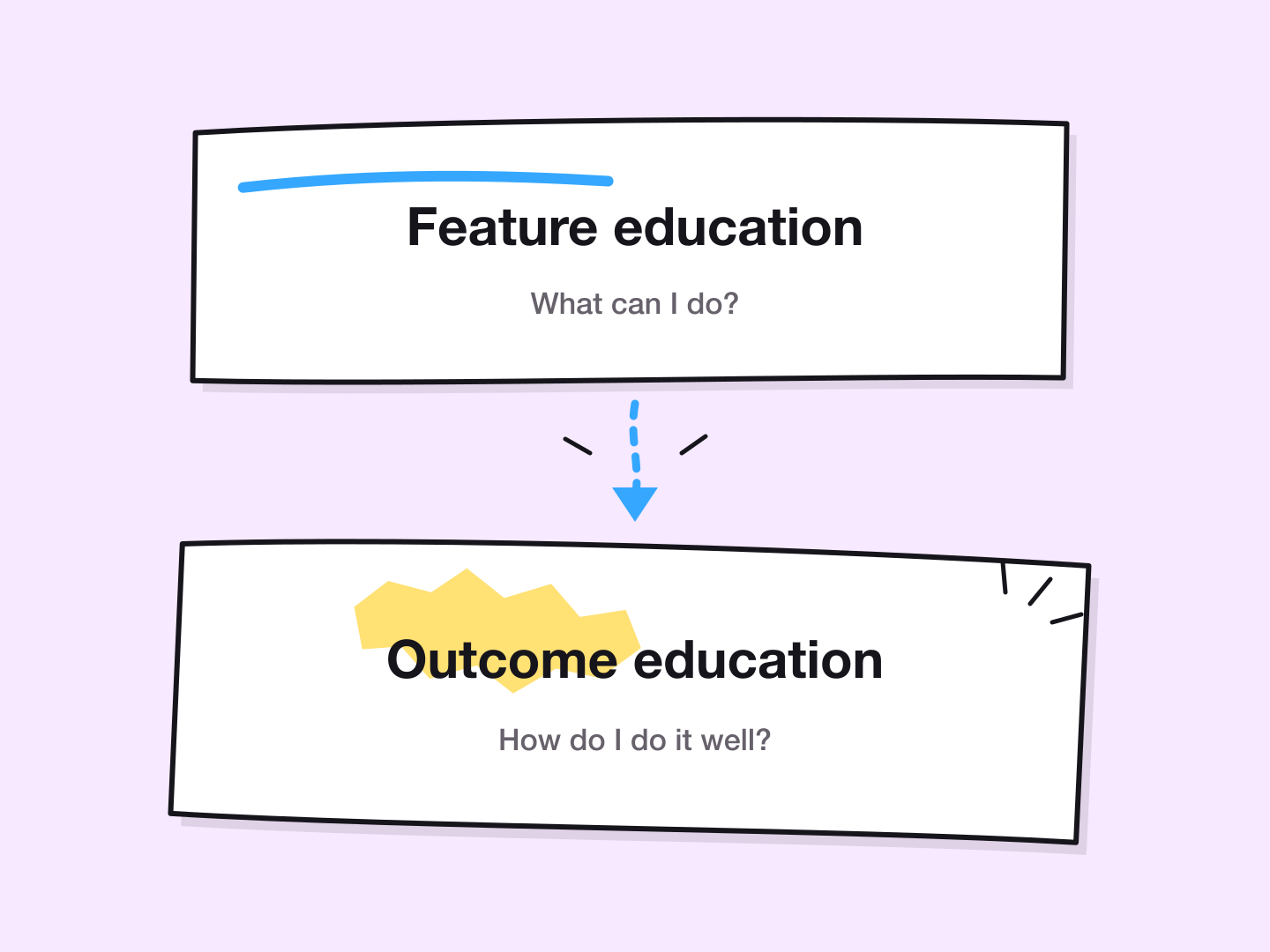
I think of the difference as feature education vs. outcome education.
- Feature education explains what the product can do.
- Outcome education helps users become better at getting value from what the product can do.
And for AI products, that distinction matters because user capability can shape perceived product quality.
🍏 Key takeaway:
Teaching users what a feature does may not be enough. AI products also need to help users understand how to get better outcomes from it.
2. Education can shorten the path to first value
This becomes especially interesting when education starts moving closer to activation.
The Google AI Professional Certificate is a useful example—and one I experienced firsthand.
The program doesn’t only explain what AI tools can do. It puts learners into real tasks: prompting more effectively, planning projects, conducting research, creating content, analyzing data, and eventually building and deploying an app with AI.
What I found useful was the shift from learning about AI to learning how to get better outcomes with AI.
For example, the app-building courses don’t stop at showing that AI can generate code. They guide learners through identifying a useful problem, turning an idea into a plan, building a prototype, testing and debugging it, and preparing it for other people to use.
That distinction matters.
Knowing that a capability exists is different from knowing how to use it effectively in a real workflow.
This is what outcome education looks like to me in practice: not simply introducing a capability, but helping users develop the skills to turn that capability into a useful result.
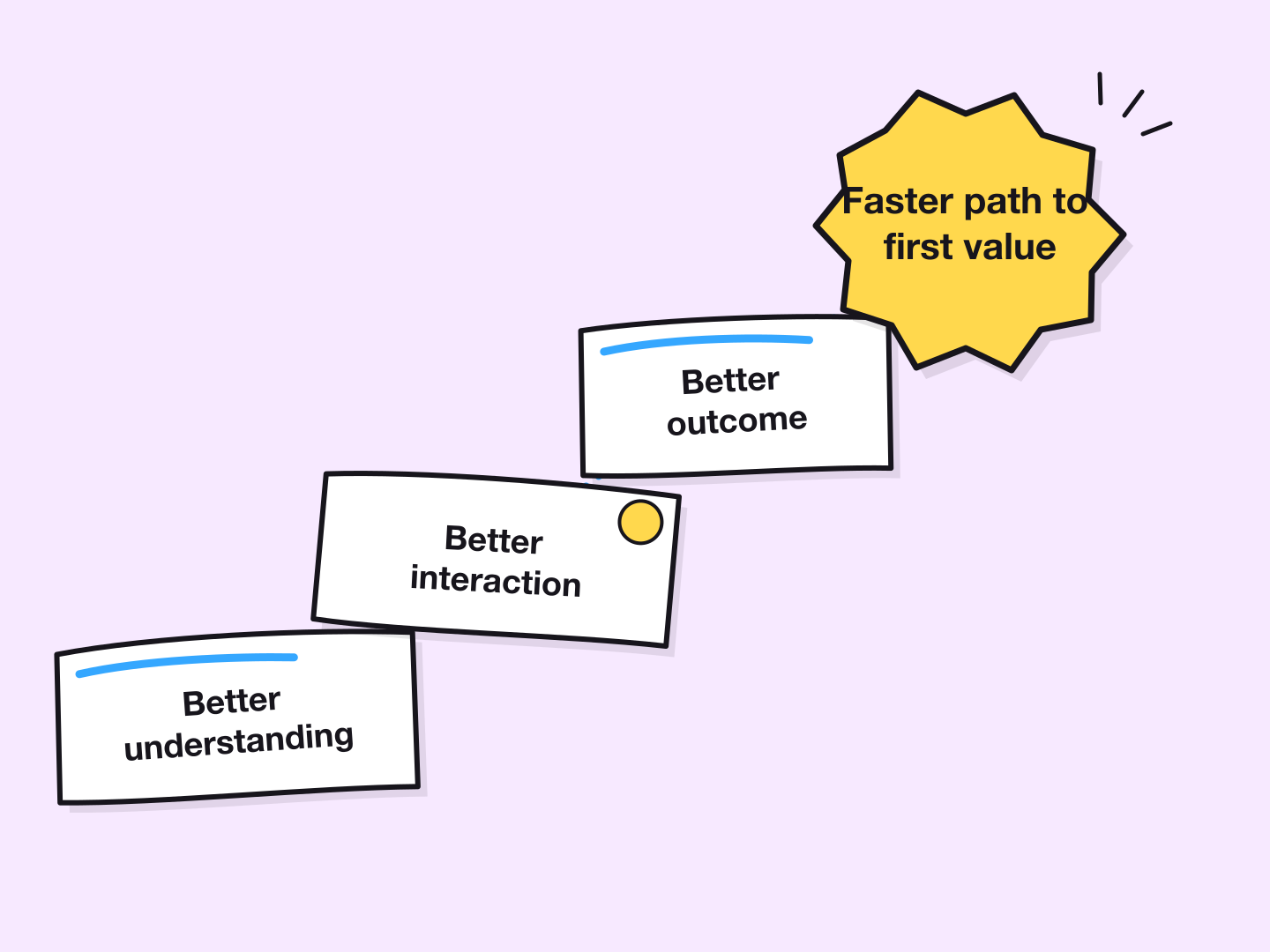
The path can start to look like this:
Better understanding → Better interaction → Better outcome → Faster path to first value
This is where user education starts to look less like a support layer and more like an activation mechanism.
It doesn’t just tell users what is possible. It can help them become better at using the product and increase the chance that they experience its value sooner.
I experienced a smaller version of this while learning vibe coding myself.
Knowing that AI could build a website was very different from knowing how to define what I wanted, give useful context, review what it produced, and iterate toward something I actually liked.
The tool had not changed. My ability to work with it had.
And that changed the value I was able to get from the same underlying capability.
🍏 Key takeaway:
Outcome education can shorten the distance between discovering what an AI product can do and experiencing its value for yourself.
3. Good education starts with knowing who is learning
Outcome education shouldn’t look the same for everyone.
Different users come to the same AI product with different goals, levels of expertise, and definitions of success.
ElevenLabs makes this particularly visible.
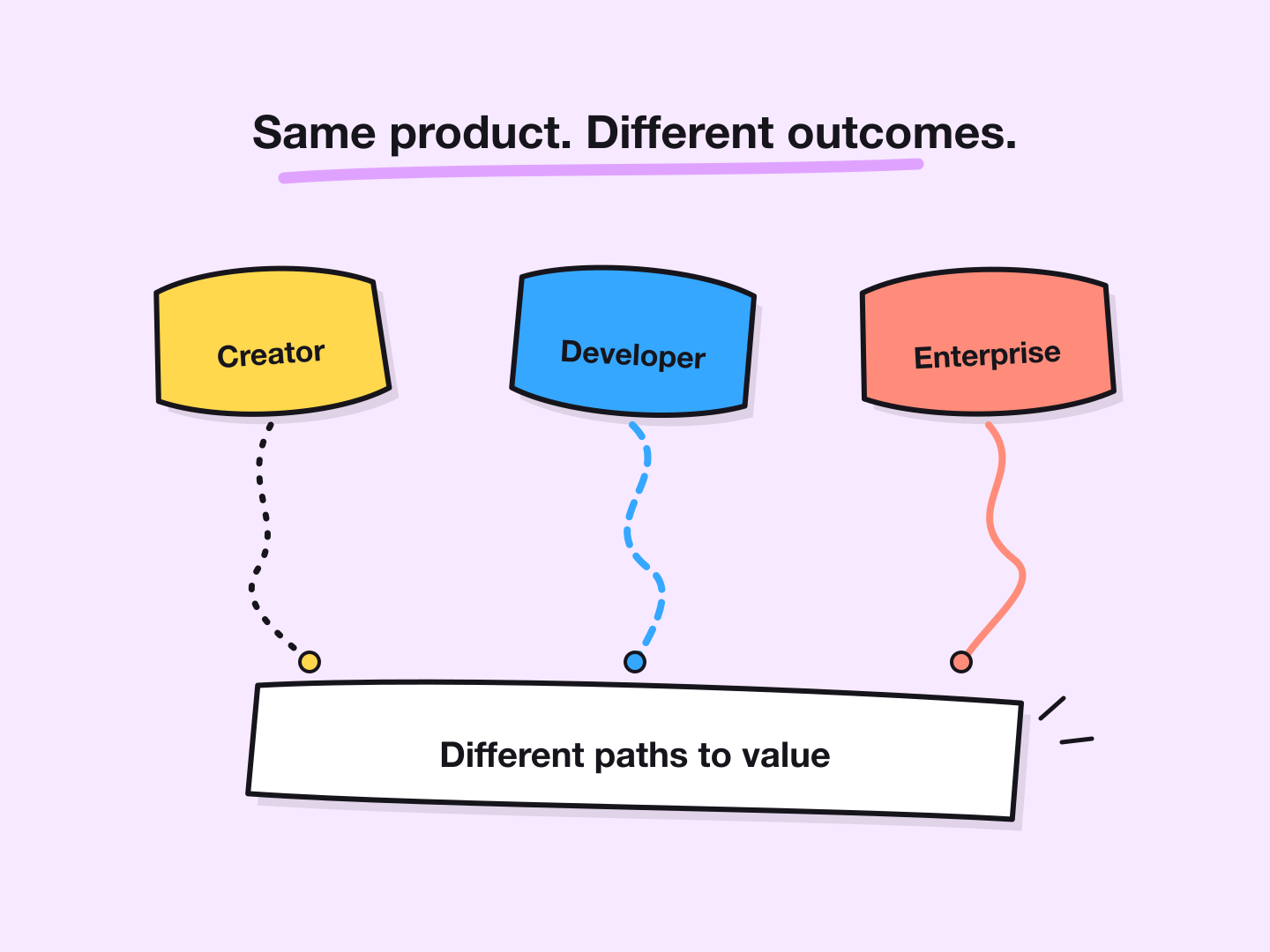
- A creator may come to an AI audio product asking: How do I create better voice, music, or audio content?
- A developer may be asking: How do I integrate these capabilities into my own product?
- An enterprise team may care much more about: How does this fit into our workflow, infrastructure, security requirements, and business use case?
Those are three very different learning problems—and three different desired outcomes.
ElevenLabs doesn’t present all of them through one generic path. Its product ecosystem separates creative workflows, developer APIs and documentation, conversational agents, enterprise use cases, integrations, and deployment support.
The underlying AI capabilities may overlap, but what each user needs to learn in order to reach value is different.
That points to something broader:
The learning need changes with the user’s job to be done.
- For creators, useful education might mean templates, examples, workflow inspiration, and guidance for producing better content.
- For developers, it may mean quick starts, API documentation, SDKs, and technical examples.
- For enterprise users, it may mean use cases, integration guidance, customer examples, security information, and deployment support.
This is where outcome education starts to overlap with segmentation, onboarding, and product marketing.
Once you know who the user is, what they are trying to accomplish, and what is preventing them from reaching value, education becomes much more than a library of help articles.
It becomes a way of guiding different users toward the outcomes that matter to them.
🍏 Key takeaway:
Good outcome education starts with the user, not the feature. Different users need different learning paths because they are trying to reach different outcomes.
From outcome education to product growth
Putting these examples together changed how I think about user education.
I used to think about it mainly as something that happens after the product exists:
Build the product → Explain the product → Help users when they get stuck
For AI products, I think the relationship can be much closer.
This is where outcome education becomes especially interesting.
If feature education helps users understand what the product can do, outcome education helps them become better at turning that capability into a successful result.
That can influence several moments in the product journey:
- Users understand what is possible.
- They learn how to interact with the product more effectively.
- Better interactions can lead to better outcomes.
- Better outcomes can help users reach value sooner.
In that sense, outcome education can create a bridge between product capability and user activation.
The relationship is not automatic. Better education alone does not guarantee activation or adoption. Product quality, use-case fit, UX, trust, pricing, and many other factors still matter.
But outcome education can influence one important part of that journey:
Outcome education → Better interaction → Better outcomes → Faster activation → Stronger chance of adoption
That makes outcome education interesting to me not only as educational content, but as a potential product growth mechanism.
🌟 Sometimes the product doesn’t need another feature
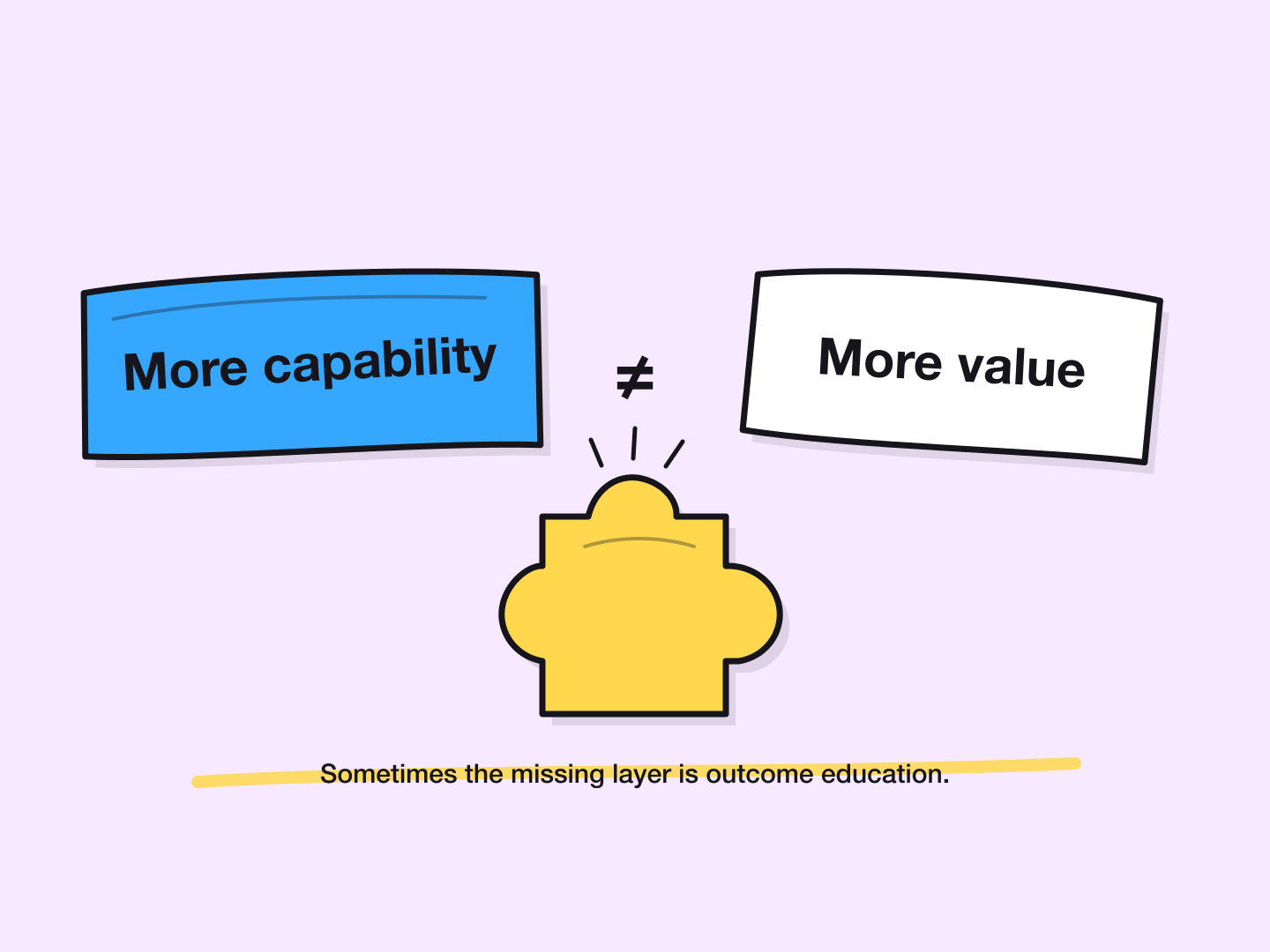
There is an understandable instinct in product building: if users aren’t getting enough value, improve the product.
And sometimes that means building something new.
But AI products have made me wonder whether there is another lever we sometimes underestimate.
What if the capability already exists, but users haven’t learned how to unlock enough of it yet?
In that case, improving the product experience may not always mean adding another feature.
It may mean investing in outcome education: helping users turn existing product capabilities into better results.
Sometimes, the opportunity isn’t to give users more capability.
It’s to help them get more value from the capability they already have.
The better users become at working with AI, the more value the product can reveal.